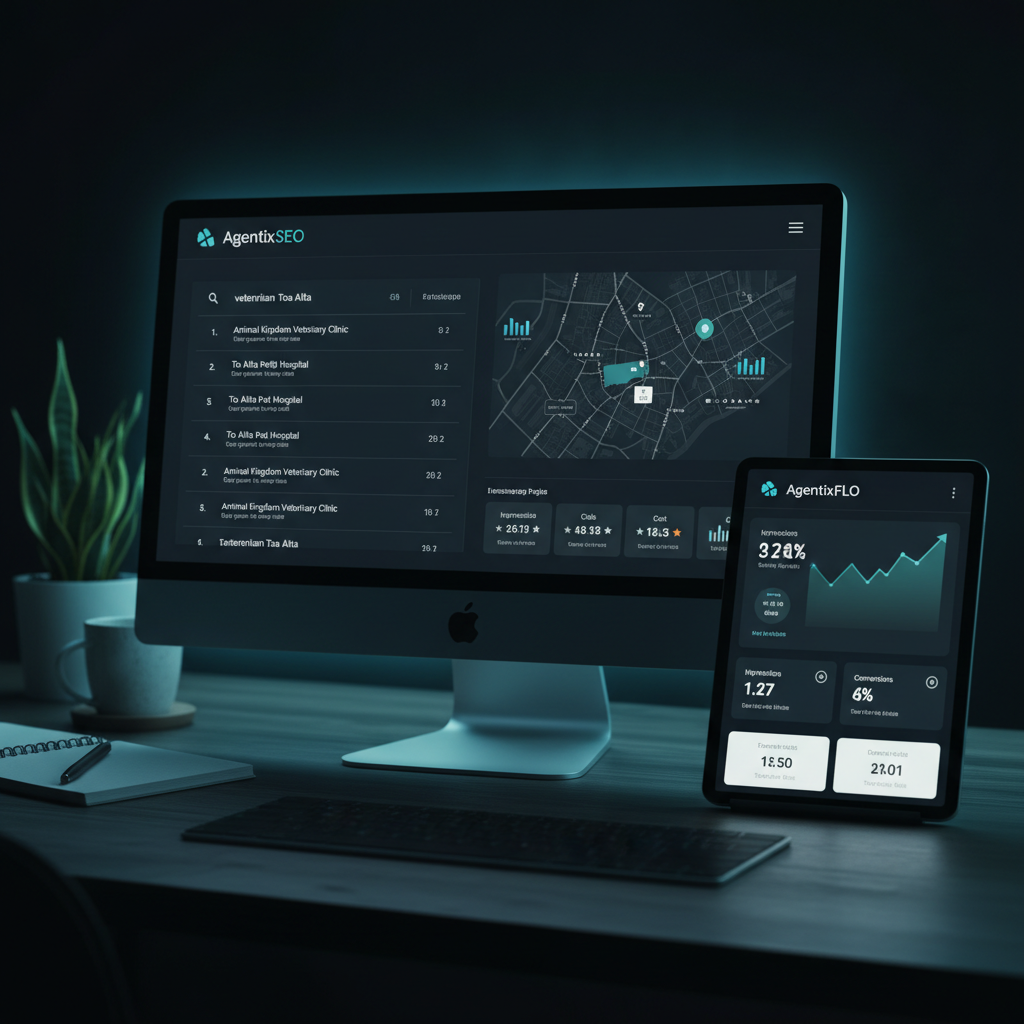
Local SEO: Scaling 50+ GBPs Without Losing Your Mind
Managing a high volume of Google Business Profiles is a major headache for agencies. This guide cuts through the noise, showing you how to scale local SEO fulfillment efficiently, without burning out your team or sacrificing results.

Managing a handful of Google Business Profiles is tactical work. Managing 50 of them is a different beast entirely. It’s an operational nightmare that burns out account managers, eats into agency margins, and turns high-value strategic work into low-value, repetitive clicking.
The siren song of local SEO retainers is strong. They seem like a stable, scalable revenue stream. But without a rock-solid operational layer, they become the fastest way to lose money and good people. The chaos multiplies. One client wants weekly GBP posts, another is obsessed with review responses, a third has a suspended listing, and ten others have photos from 2017. Your team is buried in a mountain of one-off tasks, context-switching between dozens of accounts, and trying to patch together reports that look vaguely consistent.
This isn’t a strategy problem. You know what needs to be done. It’s a fulfillment problem. The brutal truth is that most agencies aren't built to efficiently execute local SEO at scale. Your value lies in client strategy and relationships, not in the manual grind of uploading photos to 50 different GBP accounts. The path to scaling isn't hiring more junior staff to click more buttons. It’s building a system—an operator stack—that handles the execution predictably and profitably, so you can focus on what you're actually good at.
The False Promise of "Automated" Local SEO Tools
The first place most agencies look for a solution is software. A dashboard that promises to manage all your listings, schedule posts, and spit out reports. Yext, BrightLocal, Semrush’s local toolkit—they all pitch a dream of centralized control. And for a few accounts, they can feel like a godsend.
But as you scale past 10, 20, and certainly 50+ accounts, you hit a wall. The software isn't the problem; it’s the assumption that the tool is the workflow.
A tool can schedule a GBP post, but it can’t write a good one. It can’t analyze a client’s recent service calls to create a relevant Q&A. It can’t look at a negative review, understand the customer's actual complaint, and draft a response that a human needs to approve. It can’t diagnose why impressions dropped 30% month-over-month by correlating it with a change in the local pack SERP.
A tool is a dashboard. An operator is the one who makes sense of it.
For agencies, this creates a dangerous trap. You pay for the software, but you still have to pay your people to operate it. The work doesn't disappear; it just changes form. Instead of logging into GBP directly, your team is now logging into a third-party tool and still performing the same manual, cognitive tasks:
- Content Creation: Writing geo-specific, service-specific posts for a plumber in Dallas vs. a dentist in Miami.
- Reputation Management: Not just replying to reviews, but flagging spam, escalating critical feedback to the client, and identifying recurring service issues.
- Media Management: Sourcing, optimizing, and uploading client photos and videos with proper EXIF data.
- Analysis & Reporting: Moving beyond the tool's canned reports to explain what the data means for the client's business.
The tool reduces the pain of multiple logins, but it doesn't solve the core operational bottleneck: the time and expertise required to execute the work itself. This is where your margin evaporates. The subscription fee is just the beginning; the real cost is the hours your team spends using the tool. A true fulfillment layer isn't just software; it's the software plus the trained operators who run the playbook.
Building Your Core "Playbook": Standardization is Non-Negotiable
You cannot scale chaos. To profitably manage 50+ local accounts, you need a non-negotiable, standardized playbook for every stage of the client lifecycle. This isn't about treating every client identically; it's about creating a consistent foundation of execution that ensures quality and efficiency. When a new account manager comes on, you don't give them a list of clients and wish them luck. You give them the playbook.
This playbook is your agency's intellectual property. It's the "how we do it here" that separates you from the competition. For a white-label partner, this playbook is our entire business model.
The Onboarding Playbook
The first 30 days determine the profitability of an account. A messy onboarding bleeds time and creates problems for months. Your onboarding playbook should be a rigid checklist.
- Access & Verification: A standardized process for getting manager access to GBP, Search Console, and Google Analytics. No more "Can you make me an owner?" emails two months in. You need a clear SOP and a client-facing guide to make it frictionless.
- Information Intake: A detailed intake form that goes beyond name, address, and phone number. It must capture primary and secondary categories, service areas, all services/products offered, business hours for every day (including holidays), and answers to the top 10 most likely customer questions. Get this once, and you won’t have to bother the client for it again.
- Technical Baseline: A checklist for the initial audit and setup. This includes correcting NAP inconsistencies, setting up UTM tracking on the GBP website link, ensuring GSC is connected, and configuring goal tracking in GA4 for calls and form fills originating from local search.
The Monthly Fulfillment Playbook
This is the assembly line. It defines the "table stakes" work that happens every month for every local SEO client, no exceptions. This consistency is what allows for efficiency at scale. A typical monthly playbook includes:
- GBP Posts: A set number of posts per week (e.g., 2-4), cycling through different types: service highlights, offers, location-specific updates, and team features.
- Q&A Management: Proactively seeding the Q&A section with common questions (pulled from your intake form) and answering them. Actively monitoring for and answering new user-submitted questions.
- Review Management: A service-level agreement (SLA) for responding to all new reviews (e.g., within 24 business hours). This requires a clear process for drafting responses and, if needed, getting client approval for sensitive replies.
- Photo/Video Uploads: A monthly schedule for adding new, optimized media. This isn't just dumping photos; it's ensuring they have geo-tags and descriptive file names.
Standardizing this work allows you to batch tasks. One operator can handle all GBP posts for 50 clients in a fraction of the time it would take 10 different account managers to do it for 5 clients each. This is the core principle of an effective fulfillment operation.
The Reporting Playbook
Custom reports are a margin killer. Your reporting should be templatized in a tool like Looker Studio and pull from a standardized data set: GBP Insights, GSC, GA4, and call tracking. The template should be the same for every client, focusing on the metrics that matter:
- Search Views vs. Map Views
- Website Clicks
- Requests for Directions
- Phone Calls
- Keyword queries driving impressions and clicks (from GSC)
The "story" you tell around the data can be customized, but the data itself must be generated automatically. An account manager should spend their time analyzing the report and providing strategic recommendations, not screenshotting charts and pasting them into a slide deck.
The Tech Stack vs. The Operator Stack
Agencies get hung up on their "tech stack." What tools do you use? It's the wrong question. The tools are commodities. Your competitive advantage—or your fulfillment partner's value—comes from the operator stack.
The Tech Stack is the collection of software licenses: Semrush for keyword research, BrightLocal for rank tracking, CallRail for call tracking, Looker Studio for reporting. It's the raw horsepower.
The Operator Stack is the integrated system of technology, standardized playbooks, and the human operators who execute the work. It's the driver, the pit crew, and the race strategy, not just the car.
Think about it in the context of local SEO fulfillment.
- The tech stack lets you see that a client has a new 1-star review.
- The operator stack has an SLA to respond within 12 hours, a pre-approved template for negative reviews, a process for escalating egregious claims to the client, and a system for flagging recurring issues (e.g., "This is the fourth review this month mentioning a rude receptionist").
For an agency building its own fulfillment, creating an operator stack means investing heavily in process documentation and training. You need to turn tribal knowledge into a system that a new hire can learn and execute consistently.
For an agency using a white-label provider like Agentix, you are plugging into a pre-built, battle-tested operator stack. You're not just buying access to our tools; you're buying the output of our entire system. The value isn't the SEMrush subscription; it's the vetted analyst using it to find keyword opportunities for your client. The value isn't the Looker Studio dashboard; it's the data architecture and the operator who ensures it's pulling clean, accurate data that proves your agency's worth. This distinction is critical for understanding where you should invest your time and money. Do you want to be in the business of building and maintaining an operator stack, or in the business of using one to grow your agency?
Unit Economics of a GBP Account: Where Agencies Bleed Margin
Let's get blunt about the numbers. A typical small business local SEO retainer might run from $500 to $1,500 per month. An agency might budget 4-8 hours of work against that retainer. The math seems simple enough.
The problem is the hidden time-sinks that standardized fulfillment solves.
An account manager with a loaded cost of $60/hour who spends just two extra, unbilled hours on an account per month eats up $120 of gross profit. On a $750 retainer, that’s a 16% margin hit. Now multiply that by 50 accounts.
Where do these hours go?
- One-off Requests: "Can you update our hours for the holiday next week?" "Can you add this new service to our profile?" "Can you write a post about our new employee?" Each request is a context switch, an interruption that breaks workflow efficiency.
- Troubleshooting: A listing gets inexplicably suspended. The address needs re-verification. A competitor is spamming keywords in their business name. These are urgent, time-consuming fires that can derail an entire day.
- Custom Reporting: The client doesn't like the standard report and wants to see a different set of metrics, presented in a different way. Your AM now has to spend hours exporting CSVs and building a custom PowerPoint.
- Chasing Information: Begging the client for new photos, asking for details about a promotion, trying to get clarification on a technical service offering so you can write a decent GBP post.
A proper fulfillment model attacks these margin vampires directly.
The intake playbook front-loads information gathering to minimize chasing. The monthly fulfillment playbook sets clear expectations about what is and isn't included, turning one-off requests into scheduled tasks. The standardized reporting playbook eliminates custom report builds.
When you scale fulfillment through a white-label partner, you are essentially fixing your cost of goods sold (COGS). You know that for a flat fee, the core execution will be done, on time, every time. This transforms your pricing model. You're no longer selling hours; you're selling a packaged solution with a predictable margin. Your AMs are freed from the reactive busywork and can focus on client relationships, strategy, and identifying upsell opportunities—activities that actually grow account value instead of just servicing it.
Structuring Your Team for Scale (Without Hiring an Army)
The default model for agency growth is linear: add more clients, hire more account managers. This is a trap. It creates an army of generalists, each trying to be an expert in everything for their small portfolio of clients. It's incredibly inefficient.
One AM might be great at client communication but slow at technical SEO. Another might be a GMB wizard but terrible at writing compelling copy. You get inconsistent quality and massive knowledge gaps. Training becomes a nightmare.
The scalable model, and the one used by every effective fulfillment operation, is based on specialization. Instead of hiring five generalist AMs to manage 50 clients, you build a team of specialists:
- 1 Onboarding Specialist: Handles the intake and technical setup for all new clients. They become incredibly fast and thorough.
- 1-2 Content Specialists: Write all the GBP posts and Q&A content for the entire client roster. They develop expertise in crafting effective local copy.
- 1 Reputation Specialist: Manages all review responses and Q&A monitoring. They become experts in tone, de-escalation, and client communication protocols.
- 1 Reporting & Analytics Specialist: Manages all Looker Studio dashboards, data integrity, and performance analysis.
Your client-facing Account Managers now act as strategic quarterbacks. They are no longer bogged down in execution. They manage the relationship, interpret the specialists' work for the client, and focus on strategy and growth. They're project managers overseeing a well-oiled machine, not line cooks trying to do everything themselves.
This is precisely the model a white-label fulfillment partner provides. When an agency partners with Agentix, they're not just outsourcing tasks. They are plugging their client-facing AM into our specialized operator stack. Our content specialist writes the posts, our reputation specialist handles the reviews, our analytics specialist builds the report. Your AM simply delivers the finished, high-quality product to the client under your agency's brand. You get the benefits of a large, specialized team without the overhead of hiring, training, and managing them.
Tying Local SEO to a Full-Funnel View (This Is Where You Earn the Big Retainers)
Managing a GBP account is a service. Proving it generates revenue is a strategy. The agencies that command the highest retainers and have the best retention are the ones that connect the dots from local visibility to actual business outcomes. This is the final and most important piece of scaling successfully.
Stop reporting on vanity metrics like "GBP Impressions." Your clients don't care. They care about phone calls, leads, and sales. Your job is to connect your local SEO work to those bottom-line results. This requires moving beyond the GBP dashboard and integrating data from multiple sources.
- Connect GBP to Website Behavior: Use UTM parameters on your GBP website and appointment links. This allows you to isolate traffic from your GBP listing in Google Analytics 4. You can now definitively say, "Our work on your GBP drove 150 users to your website last month, and 25 of them filled out a contact form."
- Integrate Call Tracking: Use a dynamic number insertion tool like CallRail or CallTrackingMetrics. This allows you to assign a unique, trackable phone number to GBP clicks. You can now report on not just the number of calls, but the duration and even listen to recordings to qualify them as leads.
- Correlate with Paid Media: A strong organic local presence has a halo effect on paid campaigns. Higher map rankings can improve the performance and lower the cost of Google Ads Performance Max campaigns for local store goals. A well-optimized GBP provides social proof that can boost conversion rates for geo-targeted Meta Ads. Show the client how organic and paid are working together as part of a single, integrated strategy.
This level of attribution is complex to set up and maintain across 50+ accounts. It requires expertise in GTM, GA4, Looker Studio, and various ad platforms. This is often beyond the capabilities of a generalist account manager.
This is where a sophisticated fulfillment partner becomes an extension of your strategy team. A true partner doesn't just execute the basic GBP playbook. They provide the data architecture and reporting framework to prove the ROI of that work. They deliver a report that shows calls, form fills, and attributed leads—the metrics that make an agency indispensable. By handling the complex attribution layer, they empower your agency to have higher-level strategic conversations with clients, justifying your retainer and locking in long-term relationships. Scaling local SEO isn't just about doing the work more efficiently; it's about proving its value more effectively.
Frequently asked questions
What's the biggest challenge when scaling local SEO for multiple clients?+
The primary challenge is maintaining quality and consistency across dozens, or even hundreds, of Google Business Profiles. This includes managing reviews, optimizing listings, creating posts, and tracking performance without specialized tools or processes, which quickly leads to burnout and errors.
How can I avoid my team spending all their time on manual GBP tasks?+
Automation and robust internal processes are critical. Leveraging platforms that allow for bulk updates, scheduled posting, and centralized review management can drastically reduce manual effort. You also need clear SOPs for every GBP task to ensure efficiency and reduce decision fatigue for your team.
Is it truly possible to offer effective local SEO as a white-label service without deep in-house expertise?+
Absolutely. White-label fulfillment partners specialize in delivering these services at scale, often with far more expertise than an agency could build in-house cost-effectively. They handle the execution, allowing your team to focus on client strategy, communication, and retention, leveraging specialized platforms and staff.
What kind of ROI can I expect from investing in scalable local SEO solutions?+
Investing in scalable local SEO drives significant ROI by increasing client retention, allowing you to onboard more clients without proportional increases in overhead, and improving client results through consistent optimization. This translates to higher profit margins and a more sustainable agency model.
What's the most common mistake agencies make when trying to scale local SEO?+
The most common mistake is attempting to scale manual processes without sufficient technology or external support. This leads directly to inefficiency, missed opportunities for client growth, and an overwhelmed team. Without a strategic approach to automation and delegation, scalability remains an elusive goal.